

Commercial, Professional or Industrial? Choosing the Right Trade License in Dubai (2026)
Before you think about offices, visas, or bank accounts, there’s one decision in Dubai that quietly shapes everything else: which trade license you apply for. It determines what you’re legally allowed to do, which government approvals you’ll need, how your company is owned, and even how quickly you can start trading. Choose the right category and setup is smooth. Choose the wrong one and you can face rejected applications, extra fees, and weeks of delay while you amend your file.
The confusing part is that “trade license” is often used as a catch-all term, when in fact Dubai issues several distinct license types, each built for a different kind of business. This guide walks through all of them — commercial, professional, industrial, tourism, and agricultural — explains how they differ in plain English, and gives you a clear way to work out which one fits your business in 2026.
What a Trade License Actually Is
A trade license — your official business license in dubai — is the permit that lets your company legally carry out specific business activities. It is not a formality you tick off once; it is the legal foundation of your business. Every invoice you raise, every bank account you open, and every visa you sponsor traces back to the activities listed on that license.
On the Dubai mainland, trade licenses are issued by the Department of Economy and Tourism (DET), formerly known as the Department of Economic Development (DED). If you set up inside one of Dubai’s free zones instead, the license is issued by that zone’s own authority, but the category logic is broadly the same. The DET recognises five mainland license categories: commercial, professional, industrial, tourism, and agricultural. Most businesses fall into the first three, so we’ll spend the most time there.
The single most important idea to grasp is this: your license category follows the nature of your activity, not your personal preference. If you trade physical goods, you need a commercial license. If you sell expertise, you need a professional license. You don’t get to pick the one that sounds best — you match the license to what your business genuinely does.
The Commercial License
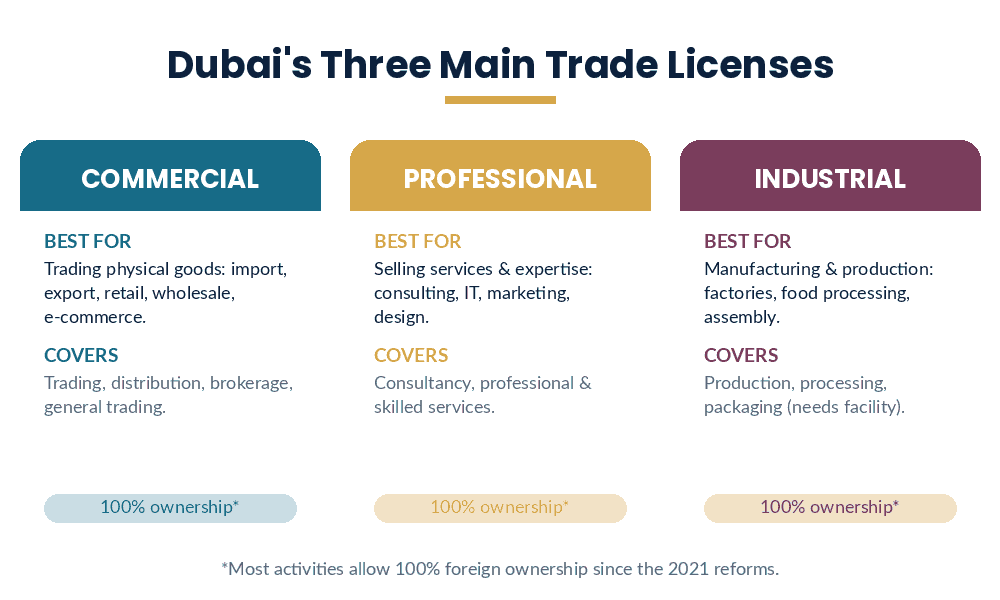
The commercial license is the most common license type in Dubai, and for good reason — it covers the buying and selling of physical goods. If your business involves products changing hands, this is almost certainly your category.
Who it’s for: importers, exporters, retailers, wholesalers, distributors, general trading companies, e-commerce sellers, and brokers. Whether you run a boutique, an online store, a car dealership, or a company importing electronics for resale, the commercial license is what legitimises that trade.
What it covers: trading, import and export, retail and wholesale, distribution, and brokerage. One of its biggest advantages is flexibility — a commercial license often allows you to combine several related trading activities under a single license, so a company importing and distributing sportswear can also retail it without needing separate permits.
The general trading option: if you want to trade across many unrelated product categories — say, electronics, furniture, and cosmetics all under one roof — you can apply for a general trading license, a broader (and slightly more expensive) form of the commercial license. It’s popular with trading houses and holding-style import/export businesses that don’t want to be boxed into one product line.
Structure and ownership: commercial businesses are typically set up as a Limited Liability Company (LLC). Since the 2021 reforms, most commercial activities allow 100% foreign ownership, so you no longer need an Emirati partner holding 51% for the vast majority of trading businesses — a major shift that made Dubai far more attractive to overseas founders.
The Professional License
The professional license is built for service-based businesses, where what you sell is knowledge, expertise, or skill rather than a physical product. If your value comes from your team’s brains rather than a warehouse of stock, this is your category.
Who it’s for: management and business consultants, IT and software firms, marketing and advertising agencies, accounting and auditing practices, legal consultancies, architects and engineers, designers, training providers, and healthcare professionals. Essentially, if you’re selling a service, this is where you belong.
What it covers: consultancy, professional services, artisan and craft work, and skilled trades. Because the emphasis is on individual competence, some professional activities require you to show relevant qualifications or experience before approval.
Structure and ownership: professional licenses are usually issued to a civil company (for two or more professionals) or a sole establishment (for a single owner). A key attraction is that professional licenses have long permitted 100% foreign ownership. Historically, mainland professional setups required a Local Service Agent (LSA) — an Emirati national who acts as a government liaison for an annual fee but holds no equity, no profit share, and no control over the business. For many service founders, the LSA arrangement is a formality rather than a genuine partnership.
Commercial vs professional — the practical difference: the quickest test is to ask what your customer is actually paying for. If they’re paying for a thing (a product, goods, inventory), you need a commercial license. If they’re paying for a service (advice, design, expertise, labour), you need a professional license. A company that both consults on interior design and sells furniture may need to think carefully — it could require a commercial license, or a combination, depending on how the activities are structured.
The Industrial License
The industrial license is for businesses that make, produce, or manufacture things. If your operation transforms raw materials into finished or semi-finished products, this is the category the law requires.
Who it’s for: manufacturers, factories, food and beverage processors, assembly plants, packaging operations, and raw-material processing businesses. From a small food-production unit to a large assembly plant, any genuine manufacturing activity falls here.
What makes it different: the industrial license carries the heaviest compliance burden of the three. Because manufacturing affects infrastructure, safety, and the environment, an industrial license almost always requires a physical facility — a warehouse or factory unit — rather than a desk. You’ll also typically need additional technical and environmental approvals from Dubai Municipality, and sometimes from the Ministry of Industry and Advanced Technology, before you can operate. Inspections and certifications are part of the process, so timelines are longer than for a service business.
Plan for it early: because of the facility requirement and extra approvals, industrial setups take more planning and a larger budget than commercial or professional ones. If manufacturing is your plan, factor the physical premises and regulatory sign-offs into your timeline from day one.
The Tourism and Agricultural Licenses
Two further categories exist for specific sectors, and it’s worth knowing they’re separate so you don’t accidentally apply under the wrong one.
The tourism license is specific to travel and hospitality. It’s issued in coordination with the tourism authority and covers travel agencies, inbound and outbound tour operators, hotels and serviced accommodation, desert safari operators, yacht charters, and cultural attractions. Given how central tourism is to Dubai’s economy, these businesses face sector-specific rules and approvals beyond a standard trade license.
The agricultural license is the least common of the five and applies to businesses in farming, crop production, fertilisers, pesticides, and related agricultural trade and services. Unless you operate in this sector, you can safely set it aside.
Mainland vs Free Zone Licenses
The five categories above are the DET’s mainland classifications. If you set up in a free zone, the zone authority issues your license instead, and while the naming can vary — you’ll see “commercial,” “service,” “industrial,” “e-commerce,” and “freelance” packages — the underlying logic of matching the license to your activity still holds.
The main practical distinction is reach: a mainland license lets you trade directly across the UAE market and take on government work, while a free zone license is ideal for international trade and businesses that operate within their zone or online. Your activity determines your license category; your market strategy determines whether you go mainland or free zone.
How to Choose the Right License
With the categories clear, choosing usually comes down to answering a few honest questions about your business:
- What is the customer paying for? A physical product points to commercial; a service points to professional; something you manufacture points to industrial.
- Will you hold or move physical stock? If yes, you’re almost certainly commercial rather than professional.
- Do you need a factory or warehouse to operate? If manufacturing is involved, budget for an industrial license and a physical facility.
- How many activities do you need? Related activities can often be grouped under one license; wildly different ones may need a general trading license or a second license.
- Who is your market? Selling across the UAE and to government favours mainland; international or online-first businesses may prefer a free zone.
Getting the activity list right at this stage matters more than almost anything else. Adding an activity later, or discovering your license doesn’t cover something a client or bank asks about, means amendments, fees, and delays. It’s worth mapping your current and near-future activities before you file.
Can You Combine Activities or Hold Multiple Licenses?
Yes, within limits. A single license can usually carry multiple activities within the same category — for example, several trading activities under one commercial license. The friction appears when you try to mix categories, such as a professional service and the trading of physical goods, which the authorities generally treat as distinct. In those cases you may need a general trading license, a commercial license with carefully selected activities, or in some situations a second license. This is exactly the kind of nuance where expert guidance on your business setup in uae pays for itself, because the right structure at the start avoids expensive restructuring later.
Renewal and Ongoing Compliance
Whichever category you choose, a trade license is an annual commitment, not a one-time purchase. Licenses must be renewed each year, and renewal is tied to keeping your tenancy (Ejari), approvals, and any sector-specific certifications current. Industrial and tourism licenses carry the most ongoing compliance because of their inspections and sector approvals, while professional and commercial licenses are generally lighter to maintain. If you’d like a full picture of what setup and renewal actually cost across free zone and mainland, see our companion guide on how much it costs to set up a business in Dubai in 2026.
Frequently Asked Questions
Is a “trade license” the same as a “commercial license”? Not exactly. “Trade license” is the umbrella term for the permit that authorises your business. “Commercial license” is one specific category of trade license — the one for trading physical goods. All commercial licenses are trade licenses, but not all trade licenses are commercial.
Can I own 100% of my company? For most professional activities, yes — full foreign ownership has long been available. Since the 2021 reforms, the majority of commercial and industrial activities on the mainland also allow 100% foreign ownership, though a small list of strategic activities can still require Emirati participation.
What happens if I pick the wrong license? You may be unable to legally perform the activity, face rejected bank or client requests, or need to amend or re-file your license — all of which cost time and money. It’s far cheaper to get the category right the first time.
Do free zones use the same categories? Broadly, yes — free zones issue their own commercial, service, industrial, and specialised licenses, following the same activity-based logic even if the labels differ slightly.
The Bottom Line
Dubai’s five trade license categories aren’t red tape for its own sake — they’re a way of matching your business to the right rules, approvals, and ownership structure. Commercial for trading goods, professional for services, industrial for manufacturing, tourism for travel and hospitality, and agricultural for farming. Identify what your business genuinely does, map your activities honestly, and choose the market you want to reach, and the right license becomes obvious rather than overwhelming.
Get this decision right at the start and everything downstream — visas, banking, growth — falls into place far more smoothly. If your business straddles more than one category, it’s worth getting advice before you file, so your license is built for where you’re going, not just where you are today.